
The short answer
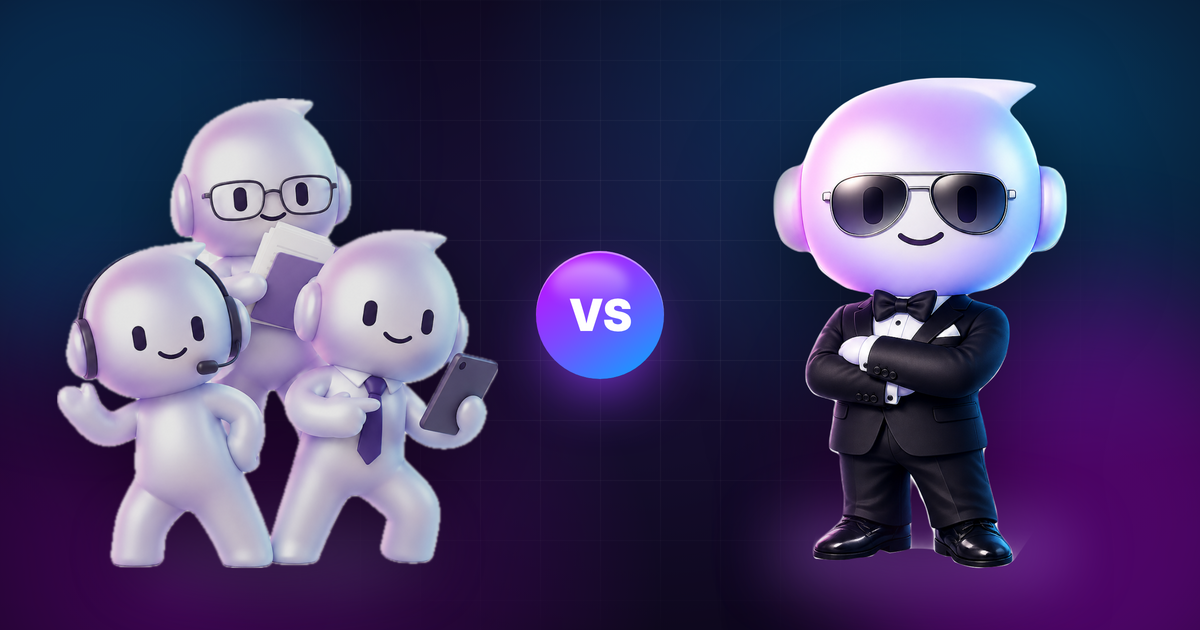
A chatbot answers. An AI agent does.
The difference is not the quality of the prose — it is what happens after your message. A bot picks a reply, from a script or from a model, and hands it back. An agent takes on the task: it plans the steps, works with files, checks the result and comes back with something finished.
Point by point
| Chatbot | AI agent | |
|---|---|---|
| What it does | Replies | Completes the task |
| Setup | Scripts, knowledge base, integrations | None — just write the task |
| Memory | Usually within one dialog | Across conversations: projects and agreements |
| Files | Usually not | Both in and out |
| Workspace | None | Isolated, one per user |
| Multi-step work | Button flows | From brief to result |
What "its own workspace" means
This is the core difference. Super Agent has an isolated working environment where it actually does the work: creates and edits files, runs tools, verifies the outcome.
Everything else follows from that:
- Files. You send a report into the chat; the agent puts it in its working folder, breaks it down, builds a summary table and returns it as a file.
- Rollback. Because the agent changes files, it needs an undo button —
/rollbackrestores everything to the state before your last message. A chatbot has nothing to roll back. - Secrets. Service credentials are not pasted into the conversation; they arrive through a one-time page (
/secrets). - Contexts. Every chat, group and topic has its own working folder, so work and personal tasks stay apart.
Memory instead of "let's start over"
A chatbot lives within one dialog, often within one message. An agent remembers context, projects and agreements: come back a week later and continue where you stopped. Want a clean slate — /new.
When a chatbot is still the better tool
Honestly: an agent does not replace everything.
If the task is known in advance and repeats thousands of times — consulting on a website, qualifying leads, answering standard questions — a scripted bot is more predictable, faster and cheaper. That is exactly why we also build classic bots and website widgets.
An agent is for work that is different every time and cannot be laid out as buttons in advance: read this document, assemble this report, finish this long piece of work.
Try it
You can write a task to the agent right now — in Telegram or in Max. The trial is 300 credits for 30 days without a card, and after that you pay for actual work.
Read next
Frequently asked questions
- What is the difference between an AI agent and a chatbot?
- A chatbot replies within a predefined script, or simply forwards your question to a model. An AI agent does the work: it has its own workspace, memory across conversations and file handling, so it carries a multi-step task through to a result.
- Does that mean chatbots are obsolete?
- No. When the task is known in advance and repeats thousands of times — website consulting, lead qualification, standard questions — a scripted bot is more predictable and cheaper. An agent is for work that is different every time.
- Do I need to train an AI agent or configure scenarios?
- No. Scripts, knowledge bases and integrations belong to classic bots. You simply write the task to an agent in plain words.